Microservices: Configuration Management
In this article we will explore config server to implement configuration management in microservices.
In a microservices architecture, a Config Server is a centralized place from where microservices obtain their configuration instead of keeping all configuration inside each service's code/deployment package.
Instead of:
user-service/
    config.py
    .env
    application.yml

hotel-service/
    config.py
    .env
    application.yml
you can have configuration managed centrally.
                    ┌──────────────────────┐
                    │     Config Server    │
                    │                      │
                    │ user-service.yml     │
                    │ hotel-service.yml    │
                    │ rating-service.yml   │
                    │ common.yml           │
                    └──────────┬───────────┘
                               │
              ┌────────────────┼────────────────┐
              │                │                │
              ▼                ▼                ▼
       User Service     Hotel Service    Rating Service
         :5001             :5002            :5003
What exactly does a Config Server do?
Imagine your user-service needs:
database:
  host: mysql.example.com
  port: 3306
  name: users

redis:
  host: redis.example.com

logging:
  level: INFO
And hotel-service needs different configuration:
database:
  host: mysql.example.com
  port: 3306
  name: hotels
A Config Server exposes these configurations through an API. For example:
GET http://config-server:8888/user-service
Response:
{
  "database.host": "mysql.example.com",
  "database.port": 3306,
  "database.name": "users",
  "logging.level": "INFO"
}
The service retrieves its configuration during startup.
So, conceptually:
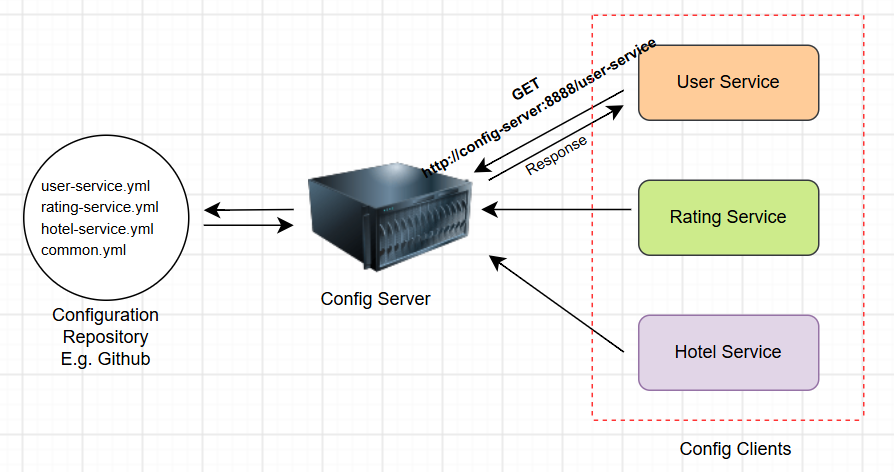
There are two ways a service can consume configuration.
1. Startup configuration
User Service starts
       │
       ▼
Fetch configuration
       │
       ▼
Start application
If configuration changes:
Change config
     ↓
Restart service
This is the simplest approach.
2. Dynamic configuration
More advanced systems allow:
Config changes
      │
      ▼
Config Server
      │
      ▼
Running microservice
      │
      ▼
Configuration updated
without restarting the service. This approach introduces additional complexity around refresh, consistency, validation, and rollback.
Why do we need Config Server?
The biggest reason is centralized configuration management.
Suppose you have 20 microservices and each has:
DB_HOST
DB_PORT
REDIS_HOST
KAFKA_HOST
LOG_LEVEL
JWT_EXPIRATION
...
Managing these independently at the application/deployment level can become painful.
With centralized configuration:
                 Config Server
                      │
       ┌──────────────┼──────────────┐
       │              │              │
       ▼              ▼              ▼
    User           Hotel          Rating
   Service         Service        Service
You can manage:
database configuration
Redis configuration
Kafka configuration
logging levels
feature flags
external API URLs
timeout values
application-specific settings
environment-specific settings
from a central location.
Different ways to implement a Config Server
There isn't just one approach. I'd categorize the options into two major approaches.
Approach 1: Dedicated Config Server
Examples: - Consul KV, Spring Cloud Config, etcd, etc.
Approach 2: Cloud Providers
Examples: - AWS Systems Manager Parameter Store
⚠️ Configuration vs Secrets
Don't treat your Config Server as a place to dump every secret.
For example:
Configuration
server:
  port: 5001

redis:
  host: redis.internal

logging:
  level: INFO

payment:
  timeout: 10
Secrets
database:
  password: SuperSecretPassword123
This should generally not be sitting in a normal Git configuration repository. Instead use something like: AWS Secrets Manager, HashiCorp Vault, Kubernetes Secrets, etc.
Then your application can have:
             Application
              /        \
             /          \
            ▼            ▼
     Config Server    Secret Manager
          │                 │
          ▼                 ▼
       settings          passwords
       timeouts          API keys
       URLs              credentials
       flags             tokens
Happy learning!